
Explainer
How Business Gas Prices Are Calculated – The Complete Business Guide
Understand commercial gas prices and how they can impact your business
Part of our business gas guides
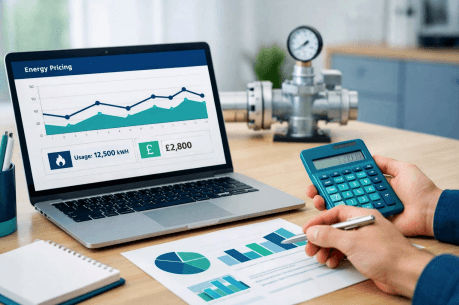
Business gas prices are determined by a combination of wholesale energy costs and various non-commodity charges. Unlike domestic energy, there is no set price cap for businesses. Each company receives a bespoke quote based on their location, annual usage, and the length of their contract. The final unit rate covers the cost of the gas itself, the pipes that carry it, government environmental levies, and the supplier margin.
If you buy power too, the electricity version of this breakdown is in how business electricity prices are calculated.
The complexity of commercial gas pricing
Looking for a quote, not an explainer? This guide covers how a business gas price gets built. If you’re here to see what rates are available for your site, our business gas comparison pulls live quotes from across our supplier panel.
Understanding how a supplier lands on a specific figure for your business gas prices can feel unclear. Most owners expect a simple price list, but commercial energy does not work like that.
The UK gas market moves quickly and prices can shift throughout the day. Because businesses use more energy than households, suppliers avoid a one-size-fits-all rate. They price around the risks and costs linked to how your site uses gas.
It helps to know the building blocks before you renew. If you also want the wider background on how business gas works, our guide on What Is Business Gas is a good starting point.
The two halves of your business gas price
At its most basic level, your gas price is split into two main categories. These are wholesale costs and non-commodity costs.
Wholesale costs refer to the price the supplier pays to buy the raw energy on the open market. This is the gas that eventually arrives at your premises to power your boilers or machinery.
Non-commodity costs are all the other charges required to get that gas from the North Sea or international terminals to your meter. This includes the maintenance of the national pipe network and various government taxes.
While the wholesale price gets the most attention in the news, non-commodity costs make up a significant portion of your total bill. Even if the price of raw gas drops, your total bill might stay high if the costs of transport or regulation increase. If you want to see exactly how each of those components gets added line by line on an actual bill, our guide on how business gas bills are calculated walks through the full breakdown.

Why every business gets a different quote
Domestic energy customers are protected by a price cap that limits what a supplier can charge. However, businesses operate in a deregulated market. This means that every quote you receive is tailored specifically to your company.
Several factors influence why your rate might be different from the business next door.
- Credit risk. Suppliers look at your credit score to decide how much risk they are taking by supplying you. A lower score might result in a higher rate.
- Annual consumption. A high-volume user like a manufacturing plant may get a lower unit rate but will face higher total costs.
- Location. The cost of transporting gas to a remote area in Scotland is different from the cost of supplying a business in central London.
- Contract length. Locking in a price for three years provides certainty for the supplier, which can sometimes result in more competitive pricing.
This bespoke nature is why it is essential to understand How Business Gas Supply Works in the UK before you sign a new contract. Suppliers need to balance their books based on exactly how much gas they think you will use and when you will use it.
What each pricing component actually does
When you look at your energy statement, the final number is usually expressed as a unit rate in pence per kilowatt-hour (kWh) and a daily standing charge.
The unit rate is where most of the complexity lies. To reach this number, the supplier adds up several different costs.
Wholesale energy usually accounts for about 60 percent of the unit rate. The remaining 40 percent consists of non-commodity costs. These are often referred to as pass-through costs because the supplier simply passes them on to you from the network operators and the government.
Government levies are a major factor here. These include schemes designed to fund renewable energy projects or to help vulnerable domestic customers. Even though you are a business, you still contribute to these national initiatives through your gas bill.
If you are looking at your current statement and wondering about specific figures, it helps to understand What Is a Unit Rate for Business Gas in more detail.
| Component | Description | Estimated % of Bill |
|---|---|---|
| Wholesale Cost | The raw cost of gas purchased on the open market. | 55 – 65% |
| Network Costs | Fees for using the national and local pipelines. | 20 – 25% |
| Environmental Levies | Government-mandated costs for green energy and social schemes. | 5 – 10% |
| Supplier Margin | The operating costs and profit for the energy company. | 5 – 10% |
| VAT and CCL | Value Added Tax and Climate Change Levy. | Varies |

How the same usage gets priced differently
To see how these calculations work in the real world, let us look at two very different businesses.
First, consider a small high-street bakery. This business uses gas for its ovens every morning. Because its usage is relatively low and predictable, the supplier can offer a steady rate. However, because the bakery does not have a massive amount of “buying power,” its unit rate might be slightly higher than a heavy industrial user. The standing charge is also a larger proportion of their small total bill.
Now, consider a large glass-making factory. This facility uses huge amounts of gas around the clock. Because the factory is a high-volume user, the supplier might offer a lower unit rate to win the contract. However, the non-commodity costs for a factory are much more complex.
The factory might be subject to higher network charges because it puts more strain on the local pipes. They also have to be very careful about Why Business Gas Prices Change because even a small shift in the wholesale market could result in thousands of pounds of extra costs every month.
The factory owner might choose a flexible contract to buy gas in stages, while the baker will almost certainly prefer a fixed rate for budget certainty.

Common misunderstandings about gas pricing
One of the most frequent misconceptions is that business gas prices are the same for everyone across the country. As we have seen, the location of your business and your credit profile make this impossible.
Another common misunderstanding is that the “price of gas” you see on the evening news is what you will pay. The news usually reports the “spot price,” which is the cost of gas for immediate delivery. Most businesses are on fixed-term contracts where the supplier has bought the gas months or even years in advance. This is why your price might not drop the moment you hear that wholesale markets are cooling down.
Many owners also assume that they can just switch to a “standard variable” rate if they do not like their current quote. In the business world, if you do not have a contract, you are often placed on “deemed” or “out-of-contract” rates. These are significantly higher than negotiated rates and are designed to encourage you to sign a new deal quickly.
Pro Tip
Always request a breakdown of your unit rate when reviewing quotes. Knowing how much is wholesale cost versus non-commodity charges can help you understand if a price increase is due to the market or a change in government policy.
Two deliveries of the same volume can produce different bills once calorific value is applied — our calorific value explainer walks through the conversion step.
Key takeaways
The way your business gas is priced depends on a complex mix of global market trends and local operational costs.
- Wholesale costs make up the largest part of your bill but are influenced by global events.
- Non-commodity costs are fixed by the government and network operators and are usually passed through to you.
- Commercial quotes are bespoke and depend on your credit score, location, and usage patterns.
- There is no price cap for businesses, making contract negotiation essential for cost control.
- It helps to compare business gas prices based on the same contract length and usage assumptions so you are looking at like-for-like quotes.
By understanding these components, you can have more informed conversations with suppliers and make better decisions for your business.
Your questions on this, answered in order
The questions businesses actually ask about this topic, in the order they tend to ask them. Each answer leads to the next; where we can help, there is a link.
How much should my business be paying for gas?
There’s no single price. Business gas rates depend on your annual consumption (AQ), location, contract length, when you buy, your credit profile, and wholesale prices at the time. Unlike households, businesses aren’t covered by a price cap. The fairest test is to compare total annual cost against current market quotes for the same usage.
Is there a price cap on business gas?
No. Ofgem’s energy price cap applies to households only. Business gas prices are set by contract, so what you pay depends on what you agreed and when. That’s why reviewing contracts before they end, and avoiding out-of-contract rates, matters more for businesses than for homes.
Why do business gas prices change so often?
Supplier prices track wholesale gas, traded at the National Balancing Point (NBP) and quoted in pence per therm. Wholesale prices respond to Norwegian and LNG supply, storage, weather, and global events. Quotes are often valid for a short time, sometimes only a day, because suppliers buy gas to back your contract when you sign.
What’s happening to wholesale gas prices right now?
In early September 2026, NBP day-ahead gas settled around 182p per therm, with Winter-26 near 183p and the Winter-27 contract around 118.50p, reflecting a premium for the coming winter and Norwegian supply outages. Prices change daily, so treat any figure as a snapshot and look at forward prices when choosing a contract length.
Can you keep me updated and quote when the market looks right?
Clearsight Energy can monitor your renewal window and come back with quotes at the points you choose, so you’re not watching the market alone. We can’t predict prices, but we can help you buy with good information. Share your end date and MPRN to set this up. Get in touch →
How long is a business gas quote valid for?
Often only for a short time, sometimes until the end of the day, because prices track the wholesale market. Some suppliers hold prices a little longer. If you need time to get sign-off internally, plan the approval process before requesting final prices so you can accept while the quote stands.
What happens if the price changes before I accept a gas quote?
You’ll need a refreshed quote at the new price, which could be higher or lower. Prices moving between the quote and your acceptance is normal in a live market. Agreeing your preferred contract length and supplier in advance means you only need a final price check on the day you’re ready to sign.
Can you send live gas prices on the day I’m ready to sign?
Yes. Clearsight Energy can agree your preferred options with you in advance, then refresh live prices on the day you’re ready so you can accept while they stand. Let us know your MPRN, end date and when your decision-makers are available. Get in touch →
What is a therm and how does it relate to kWh?
A therm is a unit of energy used for wholesale gas prices. One therm equals about 29.31 kWh. So a wholesale price of 100p per therm works out at roughly 3.4p per kWh before network, metering, supplier costs, CCL and VAT are added to reach your retail price.
Why is my business gas unit rate so much higher than the wholesale price?
Your unit rate covers wholesale gas plus transportation through the national and local networks, metering, balancing and shrinkage costs, supplier operating costs and margin, and any broker fee. CCL and VAT are added on top. Wholesale is often around half or less of the total, depending on market levels.
Can you break down my gas costs and show where I could improve?
Clearsight Energy can break down your bill into its components, compare it with current market quotes, and highlight where costs look out of line. Send a recent bill to start. We’ll explain each option in plain terms, and you’re under no obligation to go ahead with any quote. Get in touch →
Which parts of my gas price can I actually influence?
The wholesale element and the supplier’s margin vary with timing, contract length and supplier, so they’re where comparing quotes pays off. Network and policy costs are largely set for everyone. Your consumption, getting your AQ right and avoiding out-of-contract rates are the other main levers, along with the right VAT and CCL treatment.
Can you show which parts of my gas costs are worth reviewing?
Yes. Clearsight Energy can break down your current gas costs, show which elements depend on your contract and which are set across our supplier panel, and quote suitable contracts where there’s room to improve. Send a recent bill and your contract end date. Get in touch →
How does my annual gas usage (AQ) affect my price?
Suppliers price business gas in bands based on AQ. Larger users usually get lower unit rates, while very small sites may see a higher unit rate or standing charge. Your AQ also affects your microbusiness status, which is under 293,000 kWh of gas a year, and that status determines some of the protections you have.
How is my gas AQ calculated and updated?
The AQ is calculated centrally by Xoserve from actual meter readings over roughly a year, adjusted for weather. Under the rolling AQ process it’s refreshed monthly when new valid readings come in. Regular actual readings keep it accurate. Long periods of estimates can leave an AQ out of date.
My AQ looks wrong, how do I get it corrected?
Send your supplier regular actual readings, as that’s what feeds the recalculation. If your usage has changed permanently, for example after closing part of a building, ask your supplier whether an AQ correction can be raised. Keep dated photos of readings as evidence.
Can you review my AQ before I renew?
Clearsight Energy can compare your AQ with your recent readings and flag a mismatch before we request quotes, so pricing reflects how you actually use gas. Send your MPRN and a few recent readings. We’ll explain each option in plain terms, and you’re under no obligation to go ahead with any quote. Get in touch →
Am I a microbusiness for gas, and why does it matter?
You’re a microbusiness if you use under 293,000 kWh of gas a year, or have fewer than ten employees and turnover or balance sheet under €2 million. Microbusinesses get extra protections, including renewal letters, limits on notice periods and rollovers, the 12-month back-billing rule, and access to the Energy Ombudsman.
What protections do small businesses get beyond microbusinesses?
Since late 2024 Ofgem extended protections to small businesses, with fewer than 50 employees and turnover of £6.5 million or balance sheet of £5 million, or using up to 500,000 kWh of gas. They now have access to the Energy Ombudsman, suppliers must show broker fees on all non-domestic contracts, and the Standards of Conduct apply to all business customers.
What affects the business gas quotes I’m offered?
Beyond wholesale prices and your AQ, suppliers look at your location, because transportation charges vary by region, the contract length, your credit rating, payment method, and whether a broker fee is included. Two businesses with the same usage can get different quotes for these reasons.
My business was refused a gas contract on credit, what now?
Some suppliers may ask for a deposit, a security bond, or payment by direct debit if your credit score is low or you’re a new business. Others may offer a contract with different terms. Comparing several suppliers often finds an option. Avoid staying on deemed rates while you look.
Can you find a supplier that will accept my new business?
Clearsight Energy can approach suppliers with your details and explain any deposit or payment terms they ask for, so you can choose a suitable contract. Send your business details, address and MPRN. We’ll explain each option in plain terms, and you’re under no obligation to go ahead with any quote. Get in touch →
Do different sectors pay different gas prices?
Suppliers price on usage, location, contract and credit rather than sector, but usage patterns differ a lot. A restaurant, care home or manufacturer with high, steady demand looks different from an office with seasonal heating. Sector-specific factors such as VAT relief for residential care or charities can also change the final bill.
How much gas does a restaurant or pub use?
It varies with kitchen size, opening hours and heating, but hospitality sites are often among the heavier small-business gas users, because cooking and hot water run all day. Your bills or AQ give the real figure. Knowing it helps you compare quotes and spot unusual changes.
Can you quote gas for my restaurant or pub?
Clearsight Energy works with hospitality businesses and can quote gas, electricity and water for your site. Send a recent bill or your MPRN and we’ll set out suitable contracts. We’ll explain each option in plain terms, and you’re under no obligation to go ahead with any quote. Get in touch →
How do I budget for my business gas costs across the year?
Start with your annual consumption, multiply by your unit rate, then add standing charges, Climate Change Levy and VAT. Remember that gas use on heating-led sites is heavily seasonal, with much of the year’s consumption falling in the colder months. Spreading payments or setting aside cash in summer helps smooth the winter bills.
Why are my winter gas bills so much higher than summer?
Space heating drives most gas use in offices, shops, schools and care homes, and it rises sharply as outside temperatures fall. Hot water and cooking stay more constant through the year. If your summer usage is surprisingly high, check heating timers, thermostats and hot water settings, because heating running when it isn’t needed is a common cause.
Can I spread my business gas payments evenly across the year?
Some suppliers offer a fixed monthly direct debit based on your expected annual usage, reviewed periodically against actual readings. Others bill monthly or quarterly for what you’ve used. Even payments help cash flow, but regular actual readings keep the balance from drifting into a large debit or credit. Ask what options are available when you agree a contract.
My supplier has increased my gas direct debit, can they do that?
Usually, yes, if your contract allows payments to be reviewed against usage and prices. Ask the supplier to show how they calculated the new amount and give them an actual meter reading, as estimates often cause inflated reviews. If you’re in credit or the figure looks unreasonable, ask for it to be recalculated and put your request in writing.
How do I forecast my gas costs for the next two or three years?
Use your annual consumption, any known contract rates, standing charges and the confirmed Climate Change Levy rates, which are 0.801p per kWh for 2026/27 and 0.827p from April 2027. Allow for changes in occupancy or equipment, and model a range for any period after your fixed term ends, since future market prices are uncertain.
Can you quote a fixed gas price so I can budget with more certainty?
Yes. Clearsight Energy can gather fixed-price quotes for one, two or three years and set out the annual cost of each, so you can choose the term that suits your budget. Send your MPRN or a recent bill and your current end date. Get in touch →
How do degree days help me understand my gas use?
Heating degree days measure how cold a period was compared with a base temperature, so you can tell whether higher usage came from colder weather or from something changing on site. Divide your monthly kWh by that month’s degree days to get a weather-adjusted figure. If that keeps rising, it points to a fault, a setting or a change in how the building is used.
Can a smart or AMR gas meter help me track my usage?
Yes. Smart and AMR meters send readings automatically, often daily or more often, so you can see usage patterns without manual reads. That makes weather comparisons, out-of-hours waste and faults much easier to spot, and it means bills are based on actual consumption. Ask your supplier what meter you have and how to access the data.
Can you help me monitor my gas use month by month?
Yes. Clearsight Energy can help you review your gas data month by month alongside your bills, highlight unusual patterns and suggest where to look for savings. Share your MPRN and recent bills, plus portal access if your supplier provides one. Get in touch →
Why is my business gas standing charge so high?
The standing charge is a fixed daily amount covering costs such as network transportation, metering and supplier overheads, and it’s paid regardless of usage. Business standing charges aren’t capped and vary by supplier, region and contract. For low-use sites, it can be a large part of the bill, so compare it alongside the unit rate.
Can I get a business gas contract with no standing charge?
Some suppliers offer contracts with no standing charge, usually with a higher unit rate to compensate. These can suit sites with very low or seasonal use. Higher-use sites may pay more overall. Compare total annual cost for your actual consumption before choosing.
Can you work out whether no standing charge is better for me?
Clearsight Energy can compare tariffs with and without a standing charge using your real consumption and show the total annual cost of each. Send a recent bill to get a comparison. We’ll explain each option in plain terms, and you’re under no obligation to go ahead with any quote. Get in touch →
I don’t use the gas at my premises, can I stop paying for it?
If you don’t need gas at all, you can ask the supplier about having the meter removed or the supply capped, which ends the standing charge. Removal may carry a fee and reinstating later costs more. Make sure no appliances or heating depend on it, and check your lease terms first.
Can you advise whether to keep or remove an unused gas supply?
Clearsight Energy can look at the standing charge, any removal costs and your plans for the site, and help you decide. If keeping the supply makes sense, we can find a suitable low-use contract. We’ll explain each option in plain terms, and you’re under no obligation to go ahead with any quote. Get in touch →
How much should my business be paying for gas?
There’s no single price. Business gas rates depend on your annual consumption (AQ), location, contract length, when you buy, your credit profile, and wholesale prices at the time. Unlike households, businesses aren’t covered by a price cap. The fairest test is to compare total annual cost against current market quotes for the same usage.
Why is my business gas standing charge so high?
The standing charge is a fixed daily amount covering costs such as network transportation, metering and supplier overheads, and it’s paid regardless of usage. Business standing charges aren’t capped and vary by supplier, region and contract. For low-use sites, it can be a large part of the bill, so compare it alongside the unit rate.
How do I budget for my business gas costs across the year?
Start with your annual consumption, multiply by your unit rate, then add standing charges, Climate Change Levy and VAT. Remember that gas use on heating-led sites is heavily seasonal, with much of the year’s consumption falling in the colder months. Spreading payments or setting aside cash in summer helps smooth the winter bills.