
Explainer
What Is an MPRN – Decoding Your Business Gas Bill
Your Meter Point Registration Number is important for business gas contracts
Part of our business gas guides
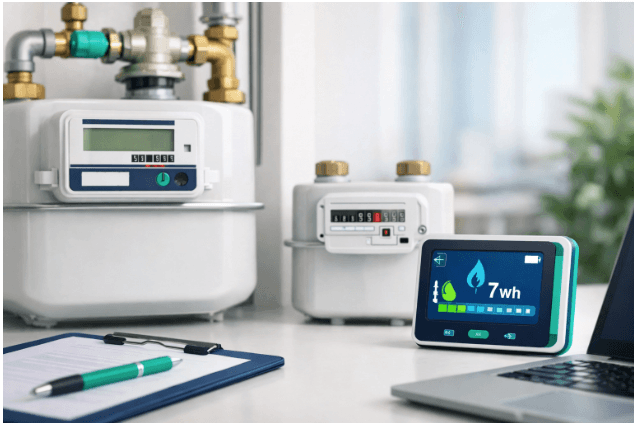
Once you know what an MPRN is, the natural next question is what about the rest of the bill? This guide walks through the inputs on a UK business gas invoice section by section, from your MPRN through AQ, calorific value, transportation, CCL, and VAT.
Once you know what an MPRN is and how it identifies your supply point, the next question is usually: what about all the other numbers on the bill? A UK business gas invoice has a dozen or more line items, codes, and reference fields. Some matter day-to-day, some only at renewal, and some only when something has gone wrong. This guide walks through them.
The anatomy of a UK business gas bill
Every UK business gas bill, regardless of supplier, has the same underlying structure. The visual layout varies a lot, but the inputs do not:
- Your MPRN, the unique supply point identifier (covered separately in our glossary entry on MPRN).
- Your AQ (Annual Quantity), the figure that drives most of the contract pricing.
- Your meter reads for the billing period, in cubic metres or hundreds of cubic feet.
- A conversion factor that turns cubic metres into kWh.
- The calorific value used in that conversion.
- Your unit rate in pence per kWh.
- Your standing charge in pence per day.
- Layered on top: CCL, VAT, and any transportation or distribution pass-through items.
Below, we take each of these in turn, in roughly the order they appear on most UK supplier bills.
Where the MPRN sits on the bill
The MPRN is usually at the top of the bill, often next to your site address. Some suppliers put it on the first page in a ‘Supply details’ box; others tuck it into the bill’s top margin or print it small. Either way, it’s a 6 to 10 digit number with no spaces or punctuation, sitting on a single line. Older meter points have shorter MPRNs; newer ones are longer.
If you can’t find it, the deeper definition and a step-by-step search are in our how to find your business gas MPRN guide.
AQ, calorific value, and the gas conversion chain
Your meter records gas usage in cubic metres (m³) or, on older meters, hundreds of cubic feet. Bills are calculated in kilowatt-hours (kWh). Converting between them needs two values: the calorific value of the gas in your area, and the conversion factor.
The formula on every UK business gas bill is:
kWh billed = Volume (m³) × Volume Correction × Calorific Value ÷ 3.6
The 3.6 converts megajoules to kWh. The volume correction adjusts for temperature and pressure. The calorific value varies by region and is published daily by the gas transporter for each LDZ.
Your AQ (Annual Quantity) is a separate figure, recalculated on a rolling monthly basis by Xoserve as new meter reads arrive. AQ drives the price band on your contract, but isn’t used in the per-bill calculation — it’s the consumption assumption that suppliers price against.
Transportation and the network costs
Behind the energy itself, every UK business gas bill recovers the cost of moving gas through the national network. Two layers of charge:
- Transportation, paid to the gas transporter (covers high-pressure transmission).
- Distribution, paid to your regional LDZ‘s operator.
On a fully-fixed contract these are bundled into the unit rate. On a pass-through contract they’re shown as separate line items, with rates that vary by LDZ, day of the year, and whether the site is on daily-metered or non-daily metering.
Together, transportation and distribution typically account for a sizeable share of a UK business gas bill, depending on geography and consumption pattern.
CCL, VAT, and other levies
Two pass-through charges show up on almost every UK business gas bill:
- Climate Change Levy (CCL), charged per kWh on non-domestic gas. The rate is set by the Treasury and changes annually each April.
- VAT, charged at the standard rate of 20% for most businesses, or at the reduced rate of 5% for very small users or eligible charities. See our reference on VAT on business energy.
On rare cases you’ll also see a Renewable Heat Incentive (RHI) levy or other niche pass-throughs. These are exception cases — most invoices have just CCL and VAT.
Standing charges and unit rates
Two pricing inputs drive the variable part of your bill:
- The standing charge, a fixed daily fee that covers the cost of having the supply available regardless of usage.
- The unit rate, the price per kWh you consume.
For most small business sites the unit rate and standing charge are negotiated as part of a fixed rate contract. For larger sites they may be on a more complex structure with separate components for energy, transportation, and supplier margin broken out.
How to spot errors when reading your bill
Routine bill validation is one of the higher-value tasks for any business with material gas spend. The common patterns to look for:
- Estimated reads instead of actual meter readings. If your bill says ‘E’ next to the read, it’s estimated. Catching this early prevents accumulation of errors.
- Wrong AQ. If your AQ is significantly above or below your actual annual usage, your unit rates may be wrong for your consumption band. The fix is a supplier request to Xoserve.
- Calorific value drift. The CV varies by region but rarely changes much month-to-month. Sudden swings are worth checking.
- Outdated meter reading dates. If reads haven’t been taken in 6+ months, the bill may not reflect actual usage.
- Wrong CCL/VAT rates. Eligibility for reduced VAT or CCL exemption changes; check the rates applied annually.
If an error gets caught, the route to fix is via your supplier first, then the Energy Ombudsman if unresolved after 8 weeks.
Key takeaways
- Every UK business gas bill is built from the same inputs: MPRN, AQ, meter reads, calorific value, unit rate, standing charge, CCL, and VAT.
- The MPRN is the unique supply point identifier. For the full definition, see our MPRN glossary entry.
- For practical steps on locating your MPRN, see our how to find your MPRN guide.
- Transportation and distribution typically account for a sizeable share of a UK business gas bill.
- Routine bill validation catches most errors before they accumulate.
Your questions on this, answered in order
The questions businesses actually ask about this topic, in the order they tend to ask them. Each answer leads to the next; where we can help, there is a link.
Where do I find my business gas MPRN?
Your MPRN, or Meter Point Reference Number, is usually on your gas bill, often labelled ‘meter point reference’ or ‘supply number’. It’s typically 6 to 10 digits. If you don’t have a bill, the Find My Supplier service at findmysupplier.energy, or the Meter Point Administration Service phone line, can give it to you from the address.
How do I find out who supplies gas to my business premises?
Use Find My Supplier at findmysupplier.energy, entering the postcode and choosing the address. It shows the current gas supplier and MPRN. You can also call the Xoserve’s gas Meter Number Helpline on 0870 608 1524, or use the Find My Supplier website, which is charged at 7p per minute plus your phone company’s access charge.
What if Find My Supplier shows no gas supplier for my premises?
The meter may be dead, capped, never registered, or connected through an independent gas transporter (iGT), which can show differently. Check whether there’s a meter on site and note its serial number. Your gas distribution network or a supplier can confirm the status. If there’s no live supply, you may need a reconnection or new connection.
Can you trace my gas meter and supplier for me?
Clearsight Energy can help trace a meter point from the site address and meter serial number, then arrange a contract once the supply is confirmed. Send the address and a photo of the meter. We’ll explain each option in plain terms, and you’re under no obligation to go ahead with any quote. Get in touch →
Is the MPRN the same as the gas meter serial number?
No. The MPRN identifies the supply point, the location where gas enters your premises. The meter serial number identifies the physical meter, which can be replaced while the MPRN stays the same. Suppliers usually need the MPRN to quote and switch, and sometimes the serial number to confirm the right meter at multi-meter sites.
I have more than one gas meter, do I need a separate contract for each?
Each meter point has its own MPRN and is registered separately, but many suppliers can group several on one contract or account, especially at multi-site businesses. Each may have its own AQ and price. Grouping makes renewals simpler, and aligning end dates across sites helps you go to market once.
Can you quote gas for all my sites in one go?
Yes. Clearsight Energy works with multi-site businesses and can quote every MPRN together, showing site-level and total costs. A list of addresses, MPRNs and end dates, or recent bills, is all we need to begin. We’ll explain each option in plain terms, and you’re under no obligation to go ahead with any quote. Get in touch →
What details do I need to get a business gas quote?
Usually the site address, MPRN, business name and type (sole trader, partnership or limited company), your current supplier and contract end date, and annual consumption. A recent bill covers most of this. Some suppliers also run a credit check, so company registration details help for limited companies.
Can I get a gas quote without a bill?
Often yes. With an address and MPRN, a supplier can usually see the AQ held centrally and price from that. If you don’t know the MPRN, it can be traced from the address. Having a bill helps confirm the details, but it isn’t always essential.
Send you my MPRN and get a gas quote?
Send Clearsight Energy your MPRN, site address, business name and contract end date, and we’ll come back with suitable contracts to compare. If you don’t have the MPRN, the address and a meter photo will usually do. We’ll explain each option in plain terms, and you’re under no obligation to go ahead with any quote. Get in touch →
Will switching gas supplier disrupt my supply?
No. The gas comes through the same pipes and meter, so switching only changes who bills you. There’s no engineer visit needed unless there’s a separate meter issue. Take a meter reading on the switch date so your final and opening bills are accurate.
Ready to switch, how do I sign up?
Once you’ve chosen a quote, Clearsight Energy sends the contract for you to sign, then handles the registration with the new supplier. We’ll confirm your start date and tell you if anything needs action. Send your MPRN and business details to begin. Get in touch →