
 Five Star Customer Service
 Stress Free Switching
 Utility Management
 Competitive Prices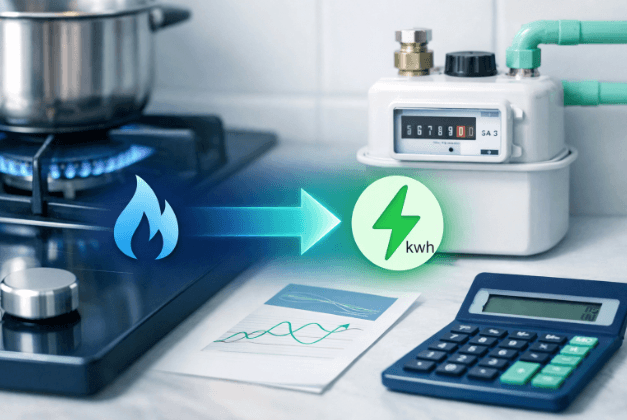
Business gas is billed in kilowatt hours (kWh), but your meter records usage in cubic metres (m³). To convert, multiply the cubic metres used by the volume correction factor (1.02264), by the calorific value of the gas (around 39.5 MJ/m³, updated monthly by National Grid), then divide by 3.6. The result is your consumption in kWh.
Worked example. A business uses 100 m³ of gas in a month. The conversion is 100 × 1.02264 × 39.5 ÷ 3.6 = 1,122 kWh. At a unit rate of 8p per kWh, that’s £89.80 of gas commodity cost for the month, before standing charges and levies.
The rest of this guide explains each step — why meters measure volume rather than energy, where calorific value comes from, and what to check if your bill looks wrong.
Why Meters Measure Volume
The reason your meter does not just show Kilowatt Hours from the start is purely down to physics. Natural gas is a physical substance that flows through pipes. As it moves into your building, the meter counts how many “pockets” of gas pass through the mechanism. This is essentially measuring the space the gas takes up, which we call volume.
However, the amount of energy in a single cubic metre of gas can change. Factors like the temperature of the air and the pressure within the pipes affect how “dense” the gas is. If the gas is cold and under high pressure, there is more energy packed into each cubic metre. If the gas is warm, it expands and contains less energy per unit of volume. Billing you purely on volume would be unfair because you might get less heating power on a warm day than a cold one.
By converting the volume into Kilowatt Hours, the energy industry creates a level playing field. It ensures that every business pays for the actual energy they use to run their boilers or industrial ovens. When you compare business gas prices, you are looking at the price per unit of energy, not the price per puff of gas.
Metric Versus Imperial Meters
Before you can start any calculations, you need to know what kind of meter you have. Most modern UK businesses use metric meters, but older commercial properties might still have imperial ones. Telling them apart is simple if you know what to look for on the face of the device.
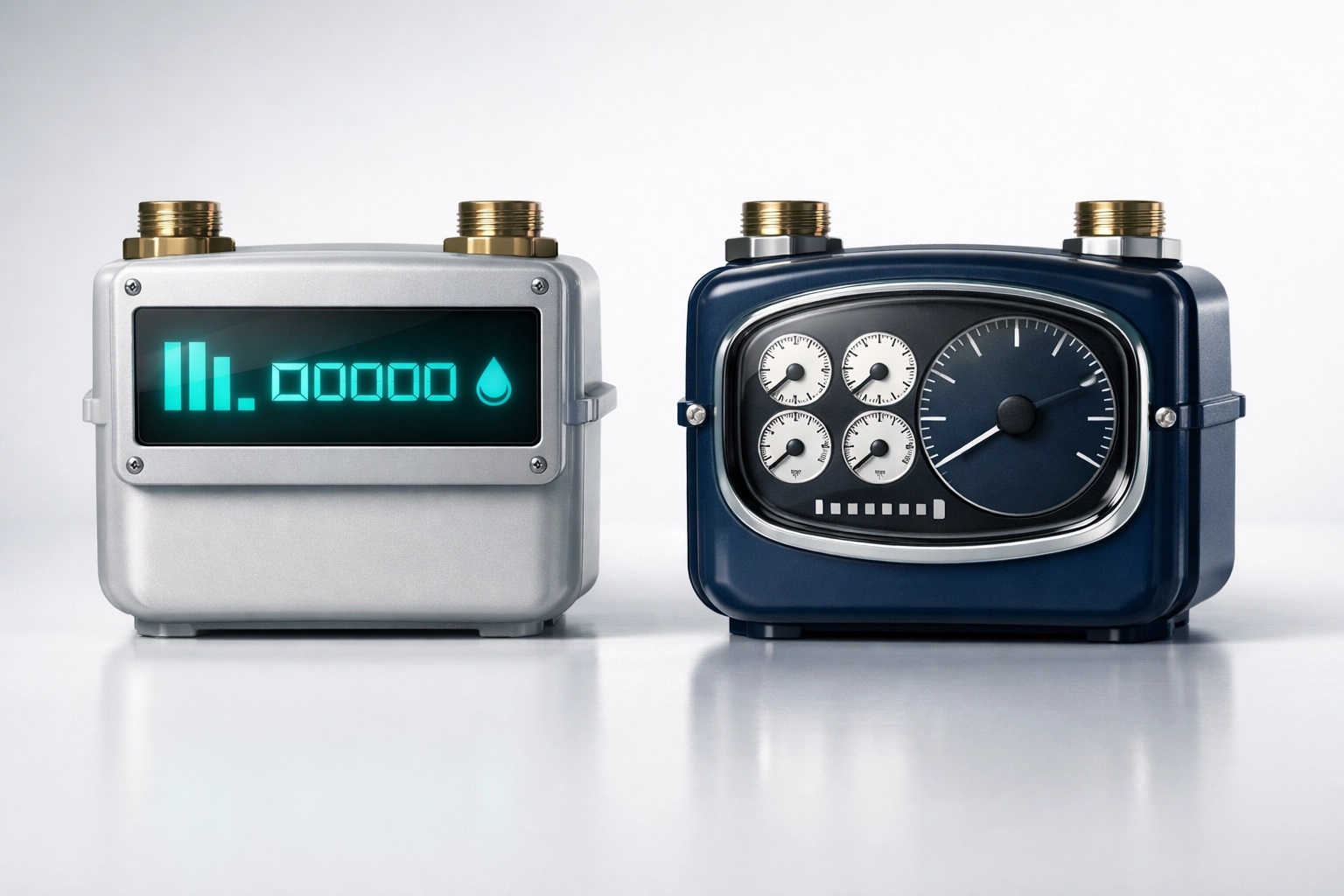
Metric meters measure gas in cubic metres. You will usually see the letters m3 printed somewhere near the digital display or the rolling numbers. If you see this, your meter is counting every 100 cubic feet as a unit. Wait, that is incorrect. Metric meters count in single cubic metres. Imperial meters are the ones that use cubic feet, often marked with the letters ft3.
If you have an imperial meter, there is an extra step in your journey. Because the standard industry formula requires cubic metres, you have to convert those cubic feet first. This involves multiplying your meter units by 2.83 to get the metric equivalent. Getting this wrong is a common cause of massive bill discrepancies, so always double check the units on your meter against the units listed on your bill.
The Conversion Components
The math used to turn your usage into kWh might look like a cat walked across a calculator, but it actually relies on four main numbers. Once you understand what these numbers represent, the mystery disappears.
- The Volume Correction Factor. This is almost always 1.02264. It is a standard industry figure that corrects the volume of gas to account for the standard temperature and pressure.
- The Calorific Value. Often shortened to CV, this represents the amount of heat energy in each cubic metre of gas. This number usually sits between 38 and 42.
- The kWh Conversion Factor. This is the magic number 3.6. It is used because one Kilowatt Hour is exactly equal to 3.6 Megajoules of energy.
- The Meter Units. This is simply the difference between your current meter reading and your previous one.
The Step by Step Formula
Now we get to the actual sums. If you have a metric meter, the calculation is a straightforward chain of multiplication and one final division. Let us walk through an example where a business uses 100 units of gas.
| Step | Action | Example Result |
|---|---|---|
| 1 | Units used (m3) | 100 |
| 2 | Multiply by Volume Correction Factor (1.02264) | 102.264 |
| 3 | Multiply by Calorific Value (e.g. 40.0) | 4,090.56 |
| 4 | Divide by kWh Factor (3.6) | 1,136.26 kWh |

If you are using an imperial meter, you simply add one step at the very beginning. You take your 100 units and multiply them by 2.83 to turn them into cubic metres. After that, you follow steps two through four exactly as shown above. It is a bit more legwork, but it ensures you are not being overcharged by a factor of nearly three.
Knowing this formula allows you to check your commercial gas prices against your actual energy consumption. If your bill says you used 2,000 kWh but your math says 1,100, you know there is a mistake that needs fixing.
Regional Differences in Gas
One of the most frequent questions business owners ask is why their Calorific Value is different from their friend who runs a shop in a different city. The UK gas grid is divided into different zones. Gas enters the grid from various sources, including the North Sea and international pipelines.
Each of these sources has a slightly different chemical makeup, which means they produce different amounts of heat when burned. The National Grid takes measurements at various points across the country every single day. They calculate the average CV for each zone to ensure accuracy.
This is why you cannot just use 40.0 as a permanent number for your own records. While it is a great estimate for a rough business gas price comparison, the real number on your bill will dance around that average. When you compare gas prices for business, the suppliers use these regional averages to estimate your future costs.
How to Spot Billing Errors
Errors in gas conversion are more common than you might think, especially when a business moves into a new property. The most common mistake involves the supplier thinking you have a metric meter when you actually have an imperial one, or vice versa.
If a supplier treats an imperial reading as a metric one, your bill will look surprisingly low. While this might feel like a win at first, it usually leads to a massive “catch up” bill later when they discover the error. Conversely, if they treat metric units as imperial, your bill will be nearly three times higher than it should be.
Check the technical section of your bill. It should clearly state the meter type and show the full calculation including the Calorific Value and Correction Factor. If these details are missing or the math does not add up, it is time to have a conversation with your provider. Having this knowledge makes you a more informed customer when looking for the best business gas supplier for your needs.

For the wider context on how business gas is bought, billed and switched in the UK, see our business gas guide.
Key takeaways
- Gas meters measure the volume of gas in cubic metres or cubic feet while bills charge for energy in kWh.
- Metric meters measure in cubic metres (m3) and imperial meters measure in cubic feet (ft3).
- Imperial meter readings must be multiplied by 2.83 before the standard conversion formula is applied.
- The standard Volume Correction Factor used by the industry is 1.02264.
- The Calorific Value (CV) varies by region and date because it represents the actual energy density of the gas in your pipes.
- To calculate kWh, multiply units by the correction factor and CV, then divide by 3.6.
Understanding the technical side of your energy usage puts the power back in your hands. It moves you away from simply trusting whatever number appears on your statement and allows you to verify that you are paying a fair price for the energy your business consumes. If you are ready to use this information to find a better deal, you can start a business gas price comparison today to see how your current rates stack up against the rest of the market.