
 Five Star Customer Service
 Stress Free Switching
 Utility Management
 Competitive Prices
Quick Summary
An MPAN (Meter Point Administration Number) is a unique identifier (traditionally 21 digits, now 22 characters following the September 2025 MHHS changes) that marks your electricity supply point in Great Britain. It’s the reference number your supplier uses to identify where you’re getting your power from, and you’ll need it whenever you switch supplier or get an energy quote. Unlike your phone number, it doesn’t change when you move suppliers.
In this Article
1. What an MPAN Is
2. How to Read Your MPAN
3. Where to Find Your MPAN
4. What the Profile Class Means
5. Why You Need Your MPAN
6. MPAN vs MPRN
7. Key Takeaways
You’re switching electricity suppliers for the first time. You’ve found a good deal, called them up to arrange the switch, and within minutes they’re asking for your MPAN number. You’re holding your electricity bill, looking at it carefully, but you’ve genuinely no idea what they mean. Your supplier rattles off a long number like it’s completely obvious. It isn’t. Not until you understand what you’re looking at.
What an MPAN Is
Your MPAN stands for Meter Point Administration Number, though you’ll also hear it called a Supply Number or S-Number if you’re talking to an older supplier who’s stuck in their ways. What it actually is: a reference code that uniquely identifies your electricity supply point in Great Britain.
Every electricity meter in the country has one. It’s assigned when your connection’s installed and it stays with that physical location for life, regardless of who owns the property or who supplies the power. You could switch suppliers five times a year, and your MPAN remains exactly the same. It’s tied to the supply point itself, not to you as a person or to your current supplier.
Think of it like a permanent address for your meter. Just as Royal Mail needs a postcode to deliver your letters, energy companies need your MPAN to deliver your electricity. It tells the industry’s central registration system which network operator looks after your area, which meter you’ve got, and what tariffs apply to your supply.
How to Read Your MPAN
That number breaks down into sections, and once you understand what each bit means, it’s not as random as it first appears.
The MPAN splits into two parts: the supplementary data (what people sometimes call the “top line”) and the core supply number. The top line handles three separate pieces of information. Until September 2025 it was 8 digits long, but following the MHHS (Market-wide Half Hourly Settlement) reform it now takes up 9 characters. The core number is the remaining 13 digits that actually identify your meter point.
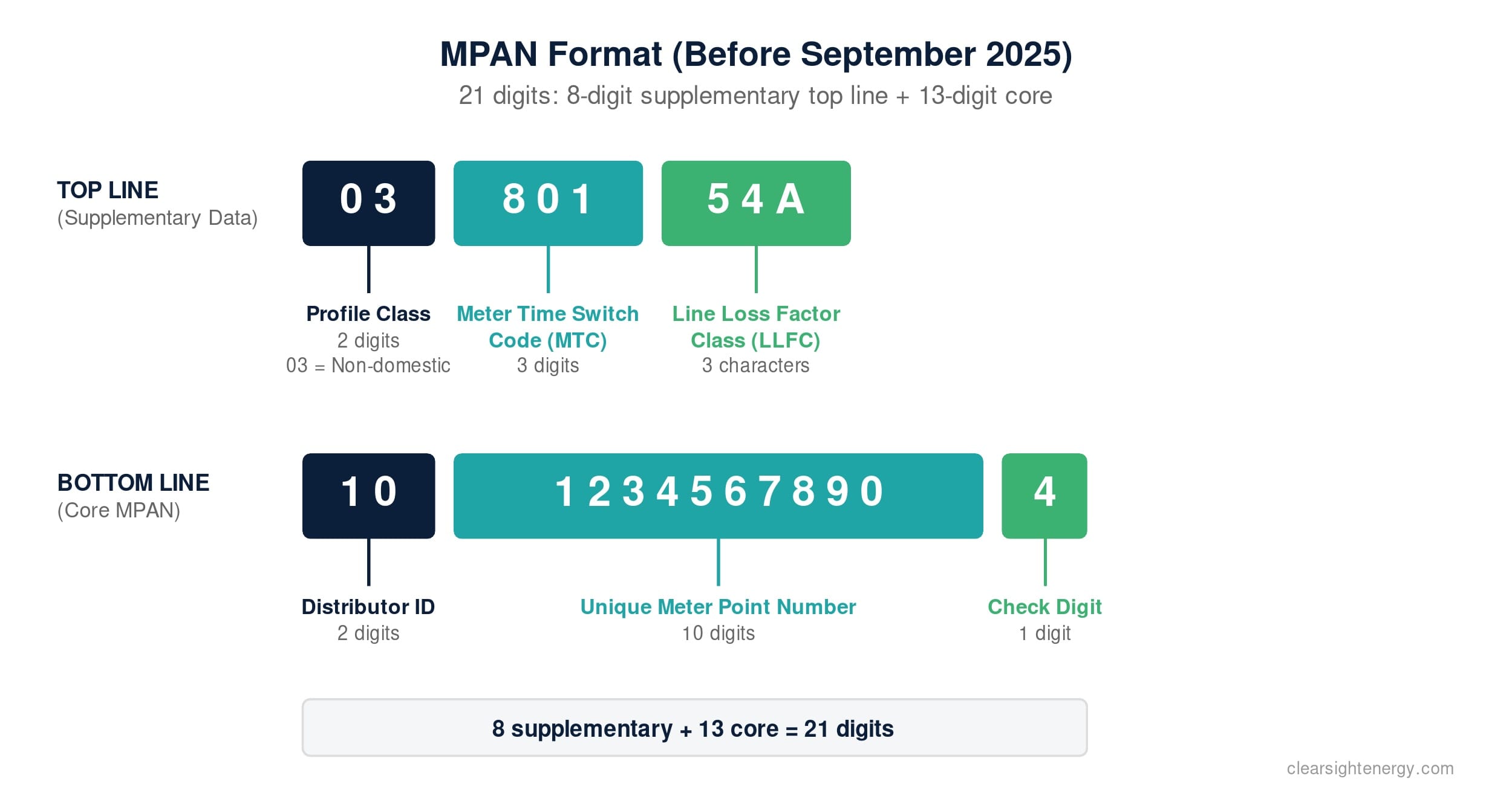
The MPAN format before September 2025 (21 digits)
In the old format above, the top line had three components sitting after the Profile Class. The Meter Time Switch Code (MTC) was 3 digits long and told suppliers how your meter split your usage across different time periods. If you were on a single rate, your MTC reflected that. If you were on Economy 7 with separate day and night registers, the MTC was different. It was basically the industry’s way of knowing what kind of tariff setup your meter had.
The Line Loss Factor Class (LLFC) was a 3-character code linked to your Distribution Network Operator. Every bit of electricity loses some energy as it travels through the wires from the power station to your meter. The LLFC identified how much loss applied in your area, and your supplier used that when working out what to charge you.
In September 2025, the MHHS (Market-wide Half Hourly Settlement) rollout changed the top line. The MTC was replaced by the Standard Settlement Configuration (SSC) ID. It does the same job, but with 4 digits instead of 3 because there are now more metering configurations to account for under half hourly settlement. The LLFC was renamed to the DUoS Tariff ID. Nothing about it actually changed in terms of what it measures. The new name just makes it clearer that it relates to your Distribution Use of System charges. The core 13-digit MPAN underneath has not changed at all.
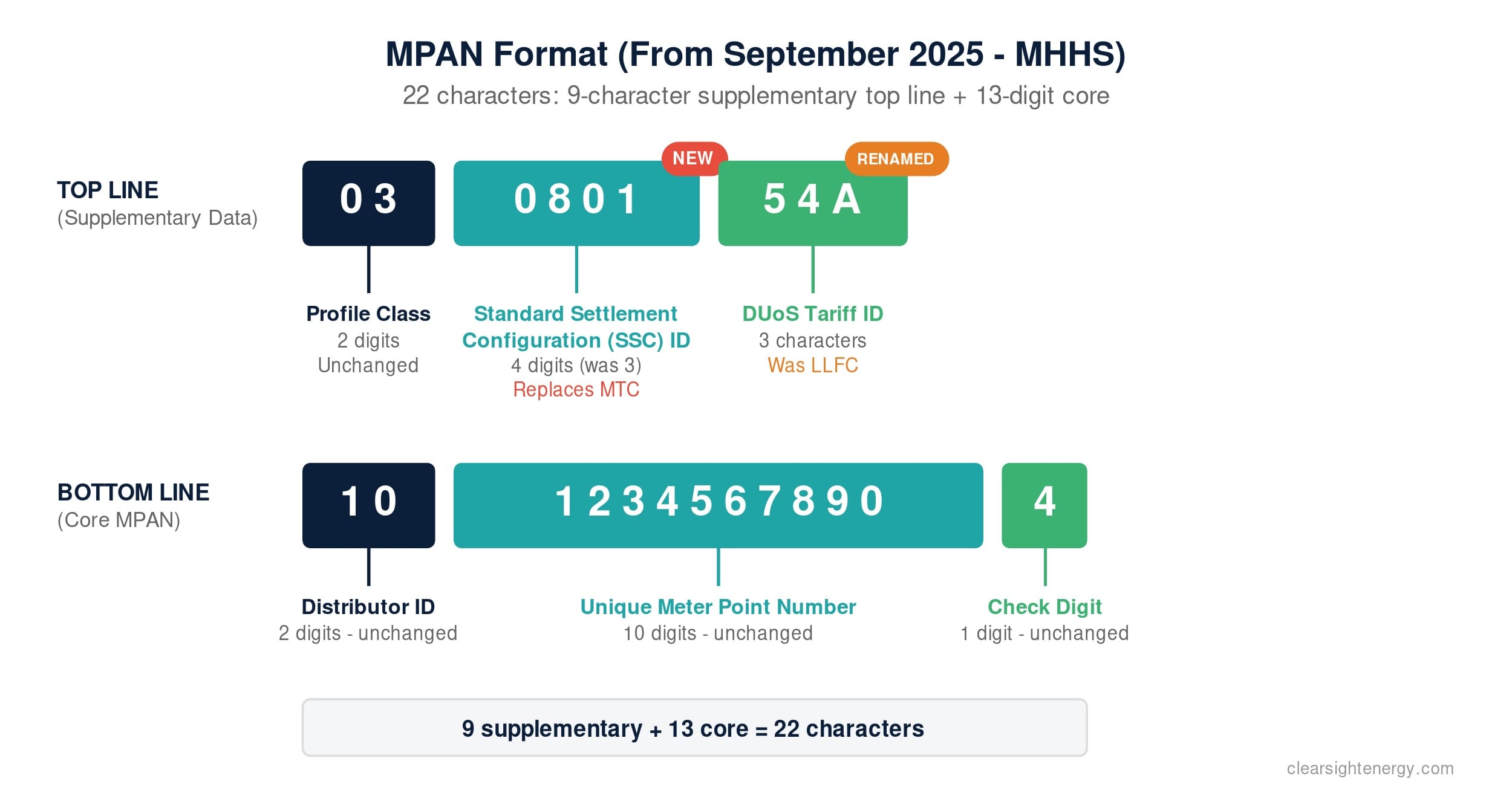
The updated MPAN format from September 2025 under MHHS (22 characters)
The first 2 digits of your MPAN are the Profile Class. This tells the electricity industry what category of consumer you are. 01 means you’re a domestic household with unrestricted access to electricity. 02 means you’re domestic but on Economy 7 (cheaper night-time rates). 03 is for small non-domestic sites with unrestricted supply, usually small businesses. 04 covers non-domestic Economy 7 or multi-register setups. Then there’s 00, and 05 through 08, but we’ll cover those separately since they work differently.
After the Profile Class come 4 digits representing your Standard Settlement Configuration (SSC) ID. This replaced the old 3-digit Meter Time Switch Code (MTC) in September 2025 as part of the MHHS rollout. The SSC identifies the specific tariff register configuration on your meter, basically how many rate bands your supply has and when they switch between them. The extra digit was added to accommodate the wider range of settlement configurations needed under half hourly settlement. If you see an older bill with a 3-digit code in this position, that was the MTC, which did essentially the same job but in the old format.
The next 3 characters are your DUoS Tariff ID, shown as two digits and a letter. This used to be called the Line Loss Factor Class (LLFC) and was renamed in September 2025 as part of MHHS. The name changed to better reflect what it actually does, which is identifying the Distribution Use of System charges that apply to your supply point. These network costs are part of what makes up your business energy standing charge. It is tied to your Distribution Network Operator and relates to the network losses in your area, which affects how your supplier prices your electricity.
The remaining 13 digits form the core supply number. The first 2 of these are the Distributor ID, a 2-digit code identifying which of the 14 distribution network operators in Great Britain manages your local network. The next 8 digits are your unique meter point number, the specific identifier for your physical meter location. Finally, there’s 1 check digit at the very end, calculated mathematically from all the other numbers to help spot if someone’s transcribed it incorrectly.
So when you see something like 01 0123 456 01 001 1234567 8, you are looking at Profile Class (01), Standard Settlement Configuration ID (0123), DUoS Tariff ID (456), Distributor ID (01), Meter Point Number (001 1234567), and Check Digit (8). It looks complicated because it is carrying a lot of technical information, but it is designed that way so the industry knows exactly what they are dealing with. If you are looking at an older bill printed before September 2025, the SSC will appear as a 3-digit Meter Time Switch Code and the DUoS Tariff ID will be labelled as the Line Loss Factor Class.
Where to Find Your MPAN
You don’t need to hunt far for this. Most of the time, your MPAN’s sitting right on your electricity bill. Have a look at the first or second page, usually under a section marked “Supply Details” or “Your Meter Details”. Energy suppliers tend to print it pretty clearly because they know people need it.
If you’ve lost your bill or you’re looking at an old one that doesn’t have it clearly marked, your meter itself might have it printed on a label. Depending on the meter model, this label could be on the front, the side, or even the back.
Your supplier can tell you straight away if you ask them. You’ve got their number on your bill, so ring or email them with your postcode and they’ll provide it in seconds. This is probably the fastest route if you can’t find it anywhere else.
You could also contact your Distribution Network Operator directly. They’re the company that manages the physical network in your area, separate from your supplier, and they have access to every supply point they look after. A quick search for “[your area] distribution network operator” will find them.
Finally, if you really want to verify your meter details are correct, the Ecoes database holds records of every electricity supply point. Your supplier can pull up your details from there, though as a customer you can’t access Ecoes directly yourself.
What the Profile Class Means
The Profile Class is where a lot of confusion comes in because it actually tells you something important about how your meter works and what tariffs you can get.
If your MPAN starts with 01, 02, 03, or 04, you’ve got a non-half-hourly meter, usually called NHH metering. This is the traditional setup where your meter gets read manually once a year. Profile Class 01 is a domestic customer with unrestricted supply, meaning you can use electricity whenever you want without time-based pricing. Profile Class 02 is domestic with Economy 7, where your supplier puts you on two different rates depending on the time of day.
Profile Class 03 is non-domestic unrestricted, mostly small businesses that don’t have heavy seasonal demand variation. Profile Class 04 is non-domestic with multiple registers or time-based pricing.
Then you’ve got 05, 06, 07, and 08. These are half-hourly metered sites. Your meter records your usage in 30-minute intervals and sends that data back to your supplier automatically. This is becoming more common, especially for businesses.
Profile Class 00 is also half-hourly settled, but it’s the newer version that’s rolling out under the MHHS programme (Mandatory Half Hourly Smart Metering). The industry’s moving everyone over to this eventually, which changes how electricity is metered and billed.
If you want to know more about the half-hourly metering rollout and how it affects you, we’ve got a detailed guide on half-hourly meters explained. There’s also more information about the wider MHHS programme on our MHHS half-hourly metering guide.
Why You Need Your MPAN
Your MPAN becomes essential the moment you’re doing anything related to your electricity supply.
When you’re switching suppliers, they won’t give you a quote without it. This isn’t them being difficult. They need it to pull your current consumption data from the system, understand what tariffs you’re eligible for, and make sure they’re quoting you for the right supply point. If you’ve got a commercial property with multiple meters, each one needs its own MPAN so they don’t mix up your supplies. Your new supplier will also ask you to sign a letter of authority to allow them to access your supply data using this number.
Getting an accurate energy quote is impossible without it. Your supplier needs to know which network area you’re in (it’s hidden in the Distributor ID), what kind of meter you’ve got, and whether you’re on NHH or half-hourly metering. Without those details, any quote they give you is a guess.
If you’ve got a billing dispute with your supplier, your MPAN helps them locate your account in their system and pull the right data. It’s a common reference point when nothing else matches up. If your current deal has expired and you have ended up on out-of-contract rates, your MPAN is what a new supplier needs to pull you out of that situation. Similarly, if you’re moving to a new property and need to set up a new supply, or if you want to add another meter to your existing property, you’ll be asked for the MPAN of the connection you’re modifying.
It’s also the reference number you’d use to verify your meter details are correct in the central register. If you suspect your meter’s been miscategorised or your supply details are wrong, your MPAN is your starting point for investigating it.
MPAN vs MPRN
It’s easy to confuse MPAN and MPRN because they sound similar and they do almost the same job, but for different fuels.
MPAN is electricity. MPRN is gas. They’re separate systems that don’t talk to each other. If you’re switching both gas and electricity, your new supplier will ask for both numbers.
An MPAN has a 9-character supplementary top line and a 13-digit core number, making 22 characters in total since the September 2025 MHHS changes. Before that it was 21 digits with an 8-digit top line. An MPRN is much shorter, usually between 6 and 10 digits depending on how your gas meter’s registered.
The structure’s completely different too. An MPRN doesn’t break down into Profile Class and Standard Settlement Configuration the way an MPAN does. Gas metering’s simpler, and it’s handled separately by different DNOs (Shires, Cadent, that sort of outfit rather than the electric networks).
When you’re getting quotes and switching providers, don’t assume the gas company can see your electricity MPAN or vice versa. They’re in different systems. Have both numbers ready. If you need help working out what your MPRN is, we’ve got a guide on MPRN numbers explained.
Key Takeaways
✓ An MPAN is a 21-digit Meter Point Administration Number that uniquely identifies your electricity supply point in Great Britain
✓ The number stays the same even if you switch suppliers, because it’s tied to the physical meter location, not to you or your provider
✓ The first 2 digits show your Profile Class, which tells the industry whether you’re domestic or non-domestic, and whether you’re on Economy 7 or unrestricted supply
✓ You’ll find your MPAN on your electricity bill under supply details, on your meter itself, or by asking your supplier
✓ You need your MPAN whenever you get an energy quote, switch suppliers, resolve billing issues, or make changes to your supply
✓ If you need an accurate quote for business electricity, your MPAN is non-negotiable
✓ MPAN handles electricity, MPRN handles gas, and they’re completely separate systems
▬▬▬
“Great customer service from Adam. Called me back very quickly, explained everything and even sent me a follow up email summarising what we discussed.”
DB, energy customer · ★★★★★ on Trustpilot
Clearsight Energy helps UK businesses compare, understand, and move to better energy contracts.
Compare business energy prices
Compare your
business utilities today!
Switch business utility suppliers
Business Energy & Utility Services
Click on one of the utilities below to compare competitive water,
electricity, and gas prices for your business.
-


Business Electricity
Switch Business Energy supplier to save on energy bills
Start Saving Now -


Business Gas
Business Gas Comparison. Compare prices online now
Start Saving Now -


Business Energy
Business Energy Comparison. Compare prices online
Start Saving Now -


Business Water
Compare business water suppliers and benefit from competitive pricing and improved customer service today.
Start saving now -


Card Payment Solutions
Receive quotes for competitive card payment solutions
Start saving now -


Commercial Waste Removal
Obtain quotes for commercial waste services for your business
Start saving now