
 Five Star Customer Service
 Stress Free Switching
 Utility Management
 Competitive Prices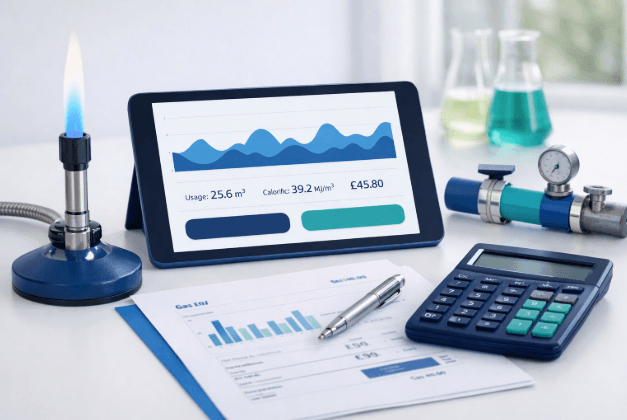
Defining Calorific Value and Why It Matters
At its simplest level, calorific value represents the heating power of the gas. Not all gas is created equal. Imagine buying two different logs for a fireplace. One might be dense oak that burns for hours, while the other is light pine that flares up and vanishes in minutes. Even though they are the same size, the energy they provide is vastly different. Natural gas works in a similar way.
Natural gas is primarily methane, but it also contains varying amounts of ethane, propane, and butane. The specific mix of these components determines how much heat is released when the gas is burned. In the UK, this is measured in megajoules per cubic metre. This measurement ensures that your business is billed for the energy you actually use to run your boilers, heaters, or industrial processes.
When you look for the best business gas supplier, you are essentially looking for the most efficient way to purchase these units of energy. If the calorific value is high, you need less volume to reach your desired temperature. If it is lower, your meter will spin faster to provide the same amount of heat. Billing by energy content rather than volume is the fairest way to handle this natural variation.
From Volume to Energy: The Conversion Process
The journey from your meter reading to your final bill involves a specific calculation. Your gas meter acts like a tally counter for physical space. It does not know how much energy is in the gas. It only knows that ten cubic metres of gas just passed through the pipes. Because the industry standard for pricing is the kilowatt hour, a conversion must take place.
The conversion process takes the volume used and multiplies it by several factors. These include a correction factor for temperature and pressure, the calorific value, and a conversion factor to turn megajoules into kilowatt hours. The calorific value used for your bill is typically an average of the values recorded in your local area during the billing period.

The standard variables involved in the energy calculation usually include the following items
- The volume of gas recorded by your meter
- A metric conversion factor if your meter reads in cubic feet
- A correction factor to account for the temperature and altitude of your location
- The specific calorific value for your local distribution zone
- A divisor to reach the final kilowatt hour figure
This process ensures that when you compare gas prices for business, you are looking at a consistent unit of measurement across all potential suppliers. Whether you are a small cafe or a large manufacturing plant, the kilowatt hour remains the universal currency of the energy market.
Why Gas Quality Changes Across the UK
You might wonder why the calorific value is not just a single, fixed number for the whole country. The reason lies in the diverse sources of gas that feed into the UK National Transmission System. At any given time, the gas in our pipes could be coming from the North Sea, imported via pipelines from Norway or continental Europe, or arriving as Liquified Natural Gas on massive tankers from places like Qatar or the USA.
Each of these sources has a slightly different chemical composition. Gas from the North Sea might have a different energy density than gas imported from overseas. As these different streams of gas enter the grid at various entry points, they mix together. However, the mix is not perfectly uniform across the entire nation.
The UK is divided into Local Distribution Zones. Depending on which zone your business is located in, you might be receiving a higher proportion of gas from a specific terminal. This geographic variation is why your neighbour in a different county might have a slightly different calorific value on their bill. It is a reflection of the physical reality of the gas network.
Measuring Heat Content with Chromatographs
To keep everything accurate and transparent, the gas network uses sophisticated equipment called gas chromatographs. these devices are installed at various points across the national and local grids. Their job is to constantly sample the gas and analyse its chemical makeup. By identifying exactly which hydrocarbons are present, the system can calculate the precise calorific value of the gas passing through that point.
These measurements are taken many times a day. The data is then used to calculate a daily average for each part of the country. When your supplier generates your bill, they pull this data to ensure the conversion from volume to energy is as accurate as possible. This high tech monitoring system prevents any guesswork in the billing process.
| Component | Role in Calorific Value |
|---|---|
| Methane | The primary combustible component of natural gas |
| Ethane and Propane | Heavier gases that increase the overall energy density |
| Nitrogen | An inert gas that can lower the calorific value if present in high amounts |
| Chromatographs | Devices that measure these components to calculate the daily CV |
This rigorous measurement process is part of what makes the UK energy market one of the most regulated and transparent in the world. It ensures that when you compare business gas prices, the underlying units you are buying are verified and consistent with national standards.
Impact on Business Gas Quotes and Billing
The variation in calorific value is generally small, usually fluctuating between 37.5 and 43.0 megajoules per cubic metre. While this might seem like a minor detail, it can have a tangible impact on large scale commercial gas prices. For a small business, the difference might be pennies, but for an industrial user consuming thousands of units, a slight shift in the energy content of the gas can lead to noticeable changes in the monthly total.

When you are in the middle of a business gas price comparison, you are typically looking at the unit rate per kilowatt hour. The calorific value is a factor that sits behind that rate, determining how many units you are actually charged for. Most suppliers will show the calorific value used for the period somewhere on the back of your bill, usually in the section explaining the conversion from units to energy.
If you find that your gas consumption seems higher than usual despite no change in your operations, it is worth checking if the average calorific value in your area has dropped significantly. While this is rarely the main culprit for high bills, it is a piece of the puzzle that every informed business owner should understand. By keeping an eye on these details, you can better manage your expectations and budget more accurately for your energy needs.
Key takeaways
- Calorific value measures the total energy or heat content available in a specific volume of gas.
- It is used to convert the physical volume recorded by your meter into kilowatt hours for billing.
- Values fluctuate based on where the gas was sourced and its specific chemical composition.
- The UK uses sophisticated monitoring across different zones to ensure accurate daily averages.
- Understanding this value helps clarify why energy bills are based on energy used rather than just gas volume.
- Regional differences in gas quality are a natural part of the national supply network.
Navigating the technical details of energy bills can feel like a full time job, but having a grasp of concepts like calorific value puts you in a much stronger position. It moves you from being a passive consumer to an informed business leader who understands the mechanics behind the costs. Whether you are currently trying to compare business gas prices or simply trying to make sense of your latest invoice, remember that the goal of these calculations is fairness and accuracy. For more information on how to keep your overheads low and manage your utility costs effectively, you can explore our full range of advice on business gas to stay ahead of the curve.
