
 Five Star Customer Service
 Stress Free Switching
 Utility Management
 Competitive Prices
The Basics of KVA and Why it Matters
Most business owners are very familiar with Kilowatt-hours (kWh). This is the unit used to measure how much energy you consume over time. However, if you run a manufacturing plant or a warehouse, another term often appears on your bill which is KVA.
KVA stands for Kilovolt-Amperes. In simple terms, this is the total pressure and flow of electricity coming into your building. It is often referred to as “apparent power” because it represents the total amount of energy the grid must be ready to provide to your site at any given moment.
If you think of your electricity supply like a water pipe, the KVA is the size of the pipe itself. The wider the pipe, the more water can flow through at once. If your machines need a massive surge of power to start up, you need a big enough pipe to handle that surge without the system failing.
Understanding this measurement is essential for industrial businesses. If your site has a KVA rating that is too low, you risk blowing fuses or causing power outages when your machinery starts up. If it is too high, you are likely paying for capacity that you never actually use.
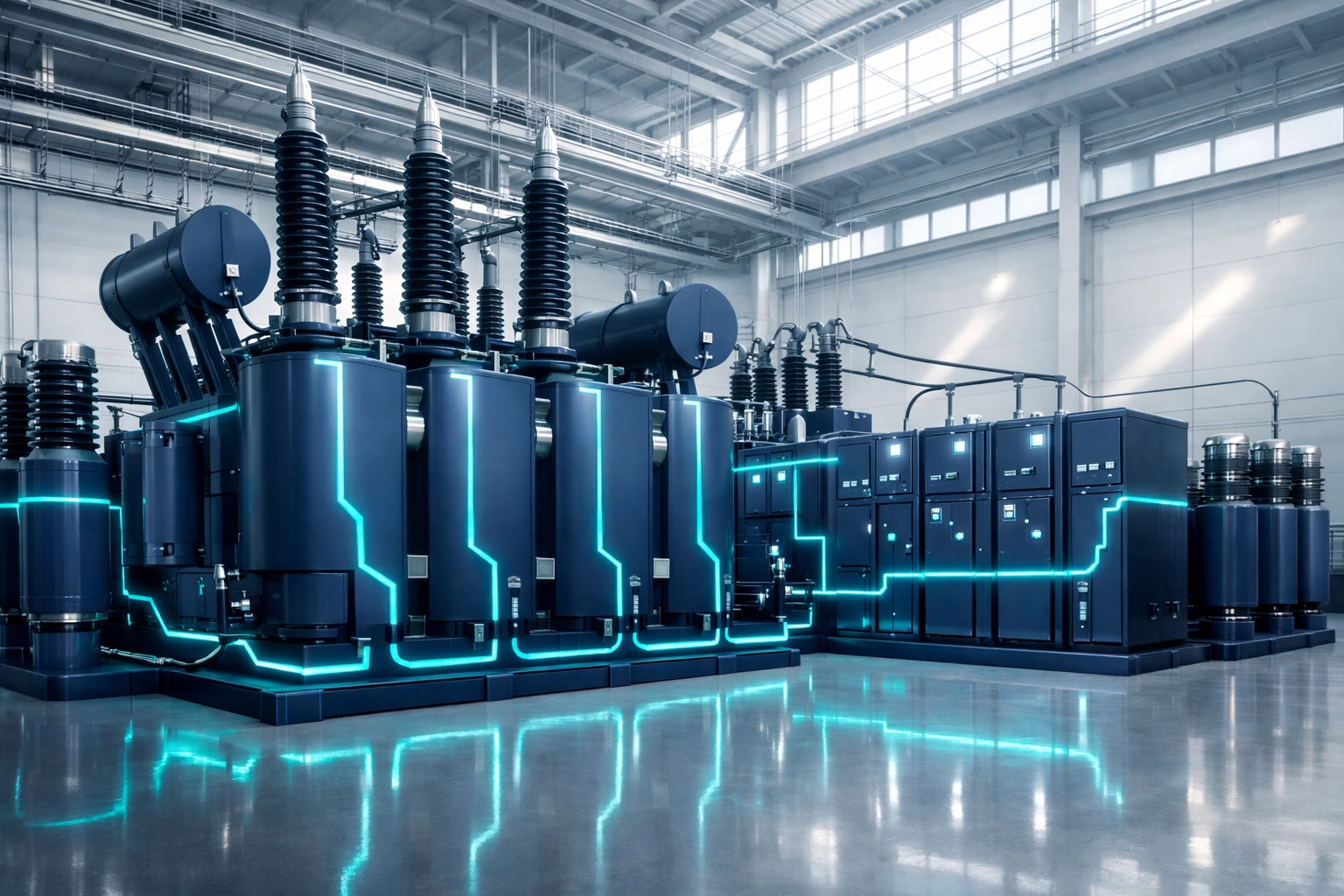
- KVA measures the total power capacity of your system.
- It is critical for sizing generators and transformers.
- It determines the Maximum Import Capacity (MIC) on your energy contract.
The Beer Analogy for Power Understanding
The easiest way to understand how KVA works compared to the power you actually use is the famous beer analogy. Imagine you have ordered a pint of lager.
When the glass is full, you have two distinct parts. First, you have the liquid beer at the bottom. This is the stuff you actually want to drink. In electrical terms, this is your Kilowatts (KW). It is the “real power” that does the actual work, such as turning a motor or heating an oven.
Then you have the head of foam on top. While the foam is part of the pint and takes up space in the glass, it does not quench your thirst. In the electrical world, this foam is “reactive power” (measured in KVAr). It is the energy required to create the magnetic fields that allow motors and transformers to work, but it does not perform any actual useful output.
The KVA is the whole glass. It is the sum of the liquid (KW) and the foam (KVAr). To get enough liquid to satisfy your thirst, you have to buy the whole glass, foam and all. This is why the grid has to supply you with KVA even if you only “consume” the KW.
Pro Tip
The more foam you have in your glass, the less beer you get for your money. In energy terms, if you have a lot of reactive power, your system is inefficient. You can improve this by using Power Factor Correction equipment to reduce the foam and maximise the liquid.
The Difference Between KW and KVA
While the two terms sound similar, they serve different purposes in the world of business energy.
KW is the amount of power that is converted into an output. If you have a 10kW heater, it will consistently pull 10kW of real power to create heat.
KVA is the amount of power being drawn from the network to make that heater work. In a perfectly efficient world, KVA and KW would be exactly the same. However, no electrical system is 100% efficient. Factors like heat loss and the creation of magnetic fields in motors mean that you always draw slightly more KVA than the KW you use.

The relationship between the two can be shown in a simple table.
| Term | What it represents | In the Beer Analogy |
|---|---|---|
| KW (Kilowatts) | Real Power (Actual Work) | The Liquid Beer |
| KVAr (Kilovolt-Amperes Reactive) | Reactive Power (Magnetic Fields) | The Foam |
| KVA (Kilovolt-Amperes) | Apparent Power (Total Supply) | The Whole Glass |
How Power Factor Influences Efficiency
The bridge between KVA and KW is something called the Power Factor. This is a number between 0 and 1 that represents how effectively your business uses the electricity it draws.
A power factor of 1.0 is perfect. It means every bit of KVA you take from the grid is being turned into useful KW. Most industrial sites operate at a power factor of around 0.8 or 0.85. This means about 80% to 85% of the power is doing real work, while the rest is being “wasted” as reactive power.
Businesses with heavy machinery, such as those in the manufacturing sector, often have lower power factors. This is because large motors require significant magnetic fields to start and run.
You can calculate your requirements using a few simple formulas.
- To find your KW, multiply KVA by the Power Factor.
- To find your KVA, divide the KW by the Power Factor.
- If you have 100 KVA and a power factor of 0.8, you have 80 KW of usable power.
If your power factor is very low, you might find that you are paying extra on your energy bills. Many suppliers add a penalty for poor power factor because it puts extra strain on the national grid.

KVA and Your Energy Bill Charges
One of the most important reasons to understand KVA is how it impacts your energy costs. For most small businesses, the bill is just based on usage. However, for larger sites, especially those with Half-Hourly (HH) meters, there is a specific charge known as the “Capacity Charge” or “Availability Charge”.
This charge is based on your Maximum Import Capacity (MIC), which is measured in KVA. This is an amount of power that you have “reserved” from the grid. Even if you do not use all of it, you pay to keep that capacity available for your site. It is like paying a reservation fee for a large table at a restaurant. Even if only two people show up, you might still pay for the ten seats you booked.
If you exceed your agreed KVA capacity, you can be hit with significant financial penalties. These are called “Exceeded Capacity Charges” and they are often much higher than your standard rate. On the flip side, if your MIC is set at 500 KVA but you never use more than 200 KVA, you are paying for 300 KVA of “air” every month.
Check your recent bills or look at the guides for your specific sector to see if you are being charged for capacity.
Managing Your Capacity for Better Efficiency
Correctly managing your KVA can lead to substantial savings. This is particularly true for businesses that have changed their operations over time. If a factory has moved from heavy machinery to lighter, more efficient automated systems, their KVA requirement might have dropped significantly.

There are three main steps to optimising your KVA.
- Review your data. Look at your Half-Hourly data to see your “Peak Demand”. This will tell you the highest KVA you have actually used in the last year.
- Adjust your MIC. If your peak usage is consistently much lower than your agreed capacity, you can ask your Distribution Network Operator (DNO) to reduce it.
- Fix your Power Factor. If your KVA is high because your power factor is low, look into Power Factor Correction. This involves installing capacitors that help handle the reactive power on-site, reducing the total KVA you need to draw from the grid.
By aligning your KVA with your actual business needs, you ensure that you have enough power to stay operational while avoiding unnecessary costs. For more detailed information on how these technical aspects affect different industries, you can explore our resources on different sectors or check out our specific help and advice section.
Understanding KVA is not just for electrical engineers. It is a vital part of managing a business that relies on power to produce goods and provide services. Once you understand the “size of your pipe” and the “foam in your beer”, you are in a much better position to control your energy overheads.
Three signs your kVA isn’t set right
1. You’re paying Exceeded Capacity Charges. Look for a line on your bill labelled “Excess Capacity” or “Exceeded Availability”. If it’s not zero, you’re going over your agreed kVA at some point in the month. Either you genuinely need a higher agreed capacity, or you’re getting hit by short peaks that better operational scheduling could iron out. A DNO uplift request takes 4–8 weeks but pays for itself in a year if the penalties are persistent.
2. Your peak demand is consistently below 70% of your agreed kVA. If your max demand never gets above, say, 80 kVA but you’re paying availability on 150 kVA, you’re paying ~£600–1,200/year for capacity you don’t use. You can request a capacity reduction. It’s free (usually) and the lower availability charge applies the following month.
3. You’ve added or removed major equipment since the supply was installed. If you’ve installed solar PV, the load you draw from the grid has dropped — and you might be able to halve your agreed kVA. If you’ve added EV chargers, refrigeration, or extra machinery, you might need to increase it.
Power factor correction — the kVA hack
If your power factor is poor (below 0.9), you can install power factor correction (PFC) equipment — typically a bank of capacitors — to bring it up close to 1.0. The effect: your kW stays the same, but your kVA drops. That can let you operate within a lower agreed kVA without losing real-power capability.
PFC equipment for a medium site (200 kVA) costs around £3,000–£8,000 installed. Payback is usually 1–3 years on capacity charges plus reduced reactive power charges.
kVA upgrades, when you genuinely need more capacity: small uplifts (e.g. 60 → 100 kVA) on an existing connection are usually under £2,000 and 4–8 weeks. Larger uplifts that need transformer or substation work can run to £10,000–£100,000 and 3–9 months. The DNO will quote, and an Independent Connection Provider can often do the contestable portion cheaper.
kVA reductions are usually free and take a couple of months for the supplier to push through.